
The free period
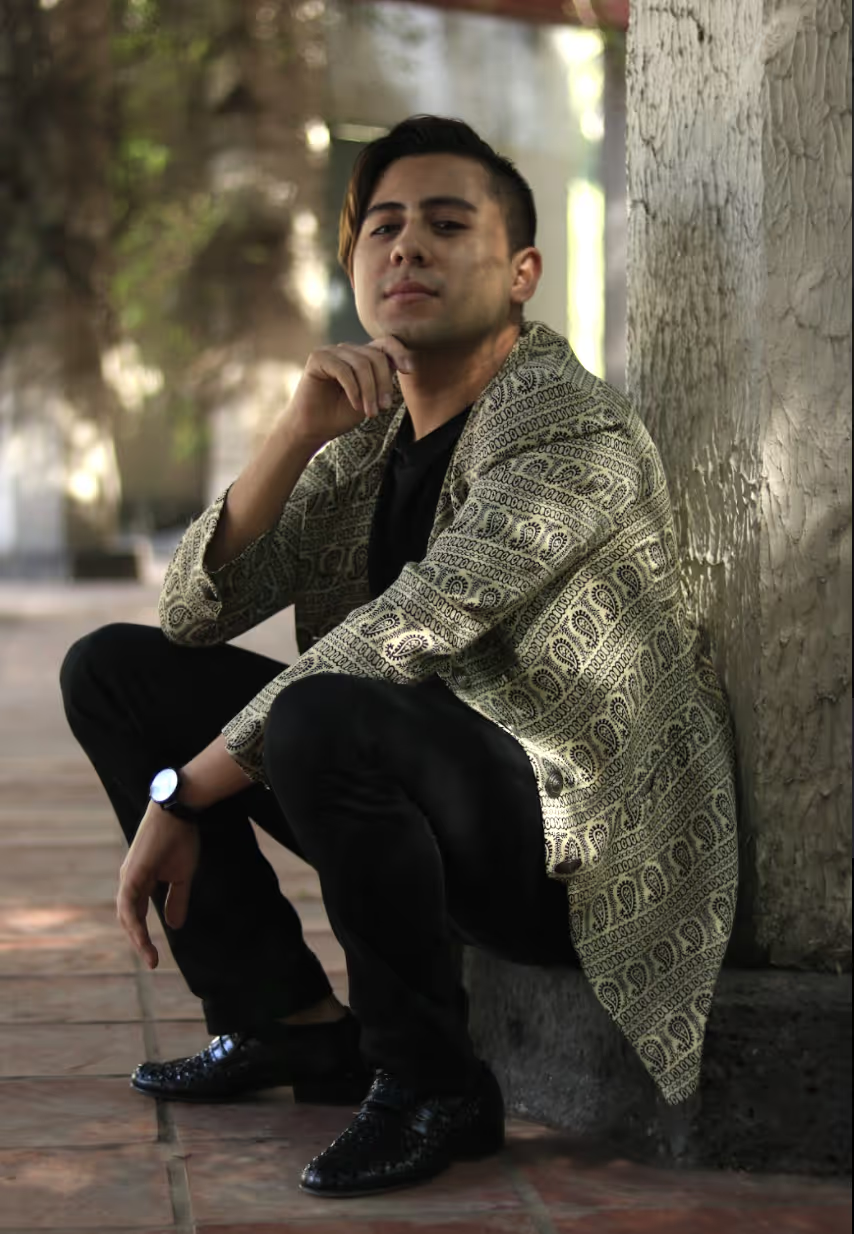
Bi Pham could have been your dentist. He very nearly was. Before he was sketching in the back of a moving car on the way to Mood, and way before Heidi Klum and Law Roach asked him to take off a jacket so he could inspect what lay beneath, Pham spent six years in pre-dental studies. Biology. Chemistry. Seminars at the dental school. “My science background is real,” he says, with the slight defiance of a man who has had to prove it. There was also, improbably, a minor in Spanish.
The detour began, as the best ones do, with an act of overachievement. Pham was born in Da Nang, Vietnam, and moved to Oregon with his family as a teenager, growing up in McMinnville and finishing at Sheldon High School in Eugene. In his senior year he was handed a free period, the most coveted thing a high schooler can own. He refused it. “Any normal kid wants a free period,” he says. “But no, I’m Asian, so I’m like, let’s fill it up.” He signed up for fashion design on a whim. At the time his wardrobe consisted of hoodies and jeans.
The class cracked something open. Pham had grown up watching his mother sew at home, but sewing, he was told, was not for him. “I’m a Catholic boy, the first son,” he says. “According to my mom, it was a girl thing.” When he graduated and announced he wanted to study fashion, she offered the immigrant parent’s eternal compromise: do something that makes money, and keep fashion on the side. He did, for years. Then he finished his science degree, applied to the Fashion Institute of Technology, and got in.
What followed was the early steps of a fashion career: two years at Dior, a retail store of his own that he ran for a year and sold, sample-making for New York designers, backstage work on other people’s runway shows. It taught him that the industry is a set of cliques. “It’s more than doing a sketch,” he says. “It’s more than sewing a dress. It’s a whole thing.”
Then came the casting call. Pham, by his own account, had 500 followers. “I didn’t think I’d get on the show,” he says. “But I did, and here I am.”
One day, no doubts
Pham is cheerfully honest about the state of his workspace. “I’m a messy designer,” he says. “My cutting table is not perfect. My sewing machine is covered in clips and pins.” He arrived intending to project a tidier image. That lasted about a day. “All of that went out the window. You’re judged on your design and your technique, not on how clean your table is.” The cameras, which he expected to rattle him, receded almost immediately; the crew, he says, shot from a distance, and he learned to zone out.
What the edit compresses is the sheer physical grind of the schedule. Designers get a single day to make a look, then a runway day that begins with three hours of finishing and stretches through setup and deliberations. If you survive, the next challenge starts at once. “Sometimes we went to Mood at 9 or 9:30 at night and got home around 11,” he says. The one weekly “dark day” is only partly dark, because there are interviews to film. His thinking time was the car ride from the studio to the fabric store, sketching while the vehicle moved.
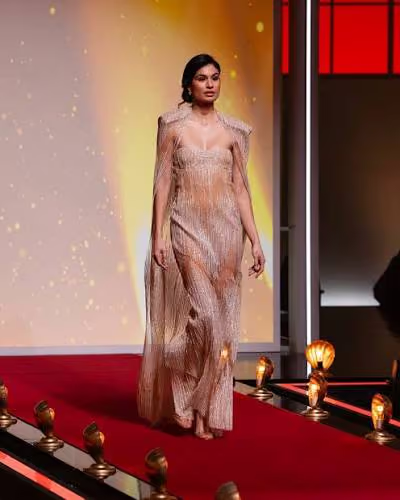
That pace rewired how he designs. For the red carpet challenge, a look for Heidi Klum, he walked into Mood already certain: sheer, glittering, Old Hollywood, one fabric only. Because it was nude, he also had to decide on the spot to build a full bodysuit matched to the model’s skin. “If you don’t decide all of that before you go in, you’ll buy the wrong fabric, the wrong trims, the wrong notions,” he explains. He calls himself “the king of pivoting,” but insists the finished look always stays true to the first idea.
Presiding over all of it is Law Roach, the stylist turned judge, whom Pham describes with something between affection and dread. Viewers have complained that the judges no longer handle the clothes up close. Pham says that misses what happens off camera. “He doesn’t skip a detail,” he says. “Sometimes he tells us to take off the jacket so he can see everything underneath. Nothing is hidden.”
The zipper nobody saw
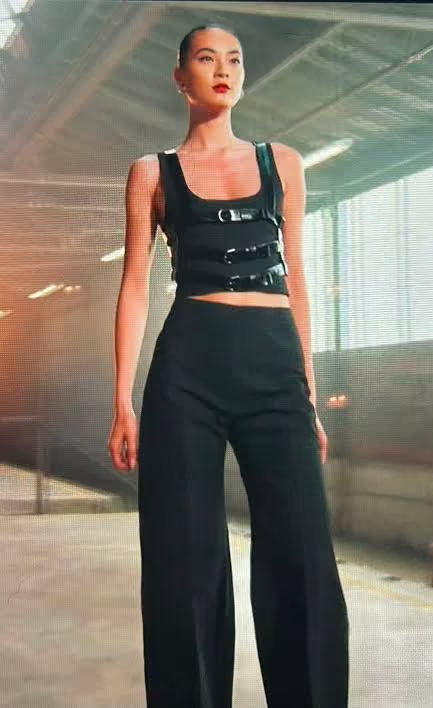
Which brings us to the paper towel challenge, and a confession Pham has never made before. “Nobody knows this,” he says. “This is an exclusive.”
His original plan was brown and red. At the store, he bought zippers to match. Back in the workroom, he looked around: everyone else was working in color, and his brown was reading, in his words, “kind of poopy.” As the clock kept ticking and a decision needed to be made, Bi decided to paint the whole thing black.
The problem was that he now had a black garment and a zipper in the wrong color. So he spray-painted the zipper too. Spray paint, it turns out, behaves a lot like glue. He held the zipper open while he sprayed and hoped the paint wouldn’t gum up between the teeth. Invisible zippers are delicate on a good day; this one survived on faith.
“It was a whole ordeal,” he says. “But you didn’t see it, because it’s hidden.” A beat. “Still.”
It is a small story, and a perfect one. A zipper can sink a dress, and on Project Runway the most consequential decisions are often the ones that never make the edit.
Old fans, new fans
Season 22 arrived as the show’s biggest gamble yet. It premiered July 9 on Freeform, streaming the next day on Hulu and Disney+, with 22 designers, the largest cast in the franchise’s history. Tyra Banks joined as a recurring judge, and the guest list ran from Iman and Winnie Harlow to Ice Spice and Nina Dobrev. It was the second season since Disney brought the show over from Bravo, with a stated aim of broadening its audience across Freeform, Hulu and Disney+.
The numbers tell the story of where that audience now lives. The Season 22 premiere drew roughly 381,000 viewers on Freeform’s linear channel. In 2009, the show’s Lifetime debut pulled 4.2 million. But the Disney-era Runway was never built for cable. Its Season 21 trailer racked up 42.7 million views across social platforms in nine days, the most-watched trailer in Freeform’s history. The audience is younger, it streams, and it meets the show in clips before it ever sits through a full episode.
Not everyone has welcomed the makeover. Longtime viewers have complained that the new edit favors interpersonal drama over the garments, that the judging feels personal, and that the format has drifted from what made the original great. A common grievance is the loss of the close-up: the old panels, with Michael Kors or Zac Posen fingering a seam, doubled as a free construction seminar.
Pham has heard all of it, and he is not about to pretend otherwise. “I know people are going to roast me for saying this,” he says, “but I don’t think the format is bad.” He recently rewatched early seasons through a podcast hosted by former contestants, and was struck by how little of the making of the original show actually aired. “They show you when you mess up, or when you’re really good or really bad. That makes good TV. Anything in between is a snooze fest.”
The construction critiques, he insists, still happen; they just aren’t always broadcast. Mentor Christian Siriano flags linings and hems, and Roach, Pham says, gives some of the most constructive feedback on set. In episode two, Roach told him his pants were too short. “Not too wide, not too narrow. Just too short.” By episode five, he had fixed it. “That feedback is for us designers,” he says, “to do better in the next episode, if you make it through.”
Pham, notably, was nearly the one who didn’t. He survived episode two only because a jury of his fellow designers voted to save him. He went on to win the unconventional-materials challenge in episode seven, an assignment built on obsolete electronics, and reached the finale, where Jude Mikulencak took the title. On the old-versus-new debate, Pham lands somewhere diplomatic. “We’re not ignoring the old audience. We love them; they’re diehard fans,” he says. “But you also have to bring new people in.”
Perfection is boring
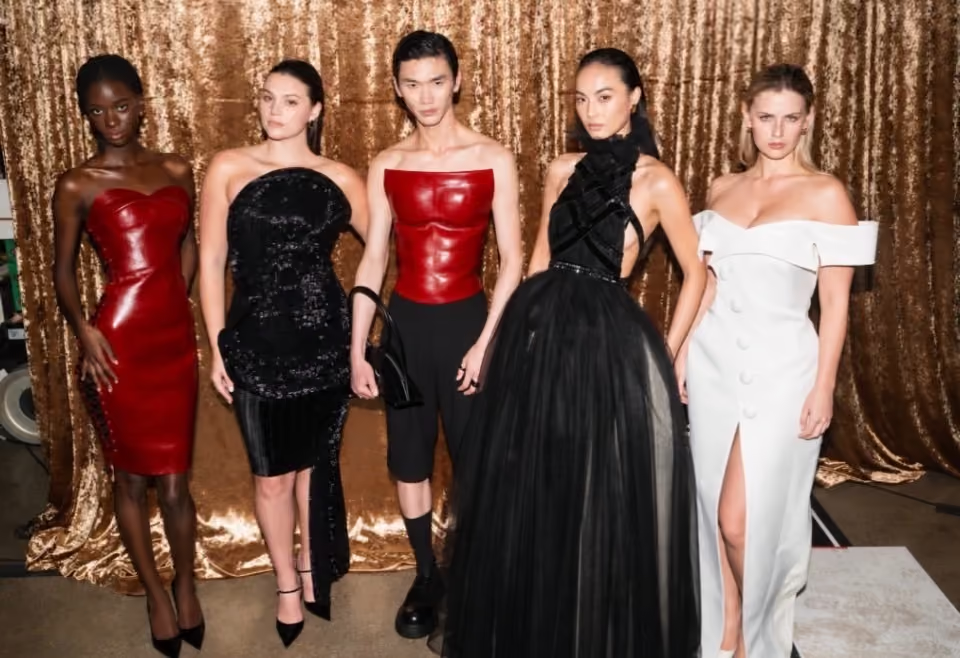
The strangest revelation of Pham’s season may be that he hadn’t designed much before it. A career spent executing other people’s visions, at Dior and in New York sample rooms, left little room for his own. “I found my aesthetic through the show,” he says, “which is so funny.”
The piece he is proudest of is the keyboard dress. He still seems faintly baffled by its afterlife. “People tell me they dream about it,” he says. “Which is crazy.”
Not everyone has always understood him. A professor once dismissed him as a technician rather than a designer. Pham took the insult and turned it into a lineage. “In that case, McQueen and Balenciaga were technicians too,” he says. He echoes something Roach told him: the simplest thing, made well and looking good, is the hardest thing to do. “That’s how I design.” His heroes follow suit: Daniel Roseberry at Schiaparelli, and Balenciaga in its earlier era. His favorite trend is, more or less, black. His least favorite is fur-trimmed shoes. “Why are you sweeping the floor as you walk?”
The show’s clock taught him one more thing, and it came with a mantra borrowed from a college professor. “Perfection is boring,” he says. “You can always be more perfect in the next project.” With no time to spiral, you make the design, adjust it, execute it, and send it out. “The best projects are the ones that are finished.” Then, with feeling: “Get it done.”
His advice to young designers is just as unsentimental. “Know your craft, please. You cannot wear a sketch,” he says. Unless you are rich enough to hire a team, and even then, you’ll have to show them how, because most people can’t read a sketch. “Unless you’re making a blazer.”
As for a celebrity that he would love to dress, Pham has one name in mind, and he’s not saying it out loud. “You already know who it is,” he says. “Law, call me.”
.avif)