
Someone once said that books are the quietest and most loyal of companions. Books survive the test of time and take you places one page at a time.
As another Pride Month arrives, the scene for the LGBTQ+ community is uncertain, and for many, scary and hopeless. Anti-LGBTQ+ hate crimes are on the rise, and just in the first half of 2026, 776 anti-trans bills have been presented throughout the country. This is legislation that would block trans and non-binary people from receiving healthcare, education, legal recognition, and the right to publicly exist.
Amidst uncertainty, targeted attacks, and increasing misinformation and disinformation, books continue to shelter the LGBTQ+ community in a way that digital spaces never will. Authors from different backgrounds tell stories and present studies that elevate the needs and interests of the community. Feelings, stories, cultures, clothes, and colors — these books are bringing people from different places to think alike. Not every individual is facing the same challenges, but in a way, there are challenges that are experienced similarly or push individuals to deal with similar struggles. These books are bringing us together to read with a sense of hope, belonging, and connection.
Fashion helps us dress our authentic selves and connect the dots of our true identity through colors, styles, fits, and accessories. But how do we know who we are at a time when history is being erased from museums, schools, and institutions? The idea of finding identity feels challenging when algorithms reward rage bait, division, and disinformation, overlooking the harm that words are causing to those who are underrepresented in our community. This would explain why books have become a trendier safe space for young LGBTQ+ individuals.
Without further ado, here are some LGBTQ+ books to read in celebration of Pride Month, identity, and love.
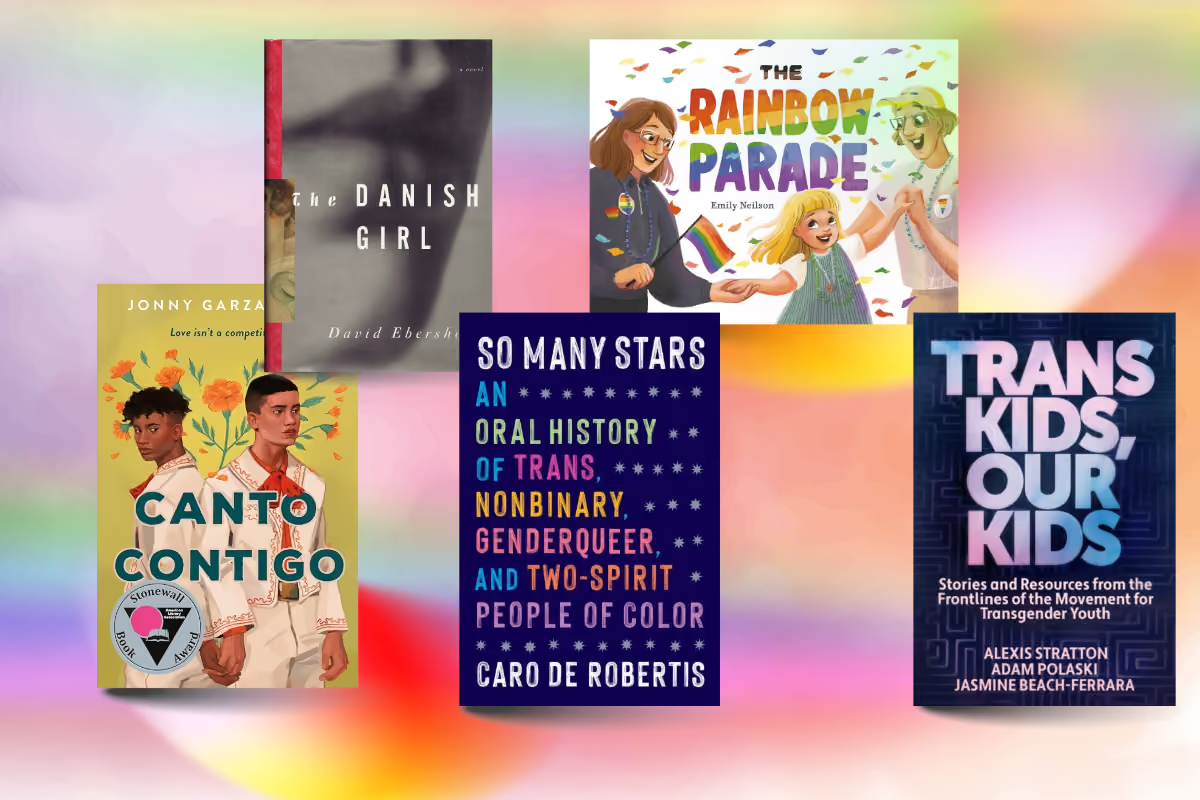
So Many Stars: An Oral History of Trans, Nonbinary, Genderqueer, and Two-Spirit People of Color by Caro de Robertis
A beautiful compilation of LGBTQ+ testimonials that touch on very personal subjects such as coming out, the journey of seeking a new home and life through the lens of being queer and an immigrant in the United States, the internal thoughts and obstacles of a person transitioning, and finding intimacy. It is very refreshing to hear people speak without filters or scripted ideas when talking about these subjects. These are not words written by an out-of-touch screenwriter in Hollywood for the sake of representation — these are the words of people speaking from experience, sharing their deepest thoughts, fears, and challenges in search of connection and wanting to feel heard.
Every story is uniquely special, and whether you are part of the community or an ally, you will find meaningful words here that will resonate with you. A story that stood out was that of Nelson D'Alerta Pérez, a longtime drag performer, artist, and cosmetologist based in San Francisco, CA. In the book, Nelson speaks about how his mother knew he was gay since he was very little. For many years, well into his adulthood, his mother encouraged him to take his own life because of how deeply she rejected who he was. The story later evolved into something more positive. Learning about these coming out stories helps us understand how these paths are so different and particularly challenging for each person.
The Danish Girl by David Ebershoff

A fictional interpretation of the life of Lili Elbe, a Danish painter who was one of the first recipients of gender-affirming surgery in 1930. The book was adapted into a film in 2015 starring Eddie Redmayne and Alicia Vikander. The story narrates with vivid detail the life of Lili Elbe, who was married to Gerda Wegener. Both were painters, and it was through Gerda's paintings that Lili found herself becoming a muse — dressing as a woman and connecting with the softness and delicacy of the dresses and skirts she wore while posing for Gerda's work.
Although both Lili and Gerda existed in real life, the book does not aim to be a journalistic account of their relationship or the outcome of Lili's surgery. Instead, it imagines what those conversations were like — the challenges, pains, and struggles Lili must have faced in deciding to be one of the first people to undergo gender-affirming care. Simultaneously, it captures the love and support that Gerda must have offered Lili throughout a long, difficult, expensive, and painful transition that was barely discussed in the 1930s.
The Rainbow Parade by Emily Neilson

An illustrated children's book that narrates the story of a child attending an LGBTQ+ parade for the first time with her two mothers. When the book came out in 2022, it sparked debate and outrage about whether it was appropriate to discuss Pride Month with children and whether the content should even be accessible to them. Yet the book has been endorsed by leaders, activists, and entrepreneurs who have promoted it as an insightful tool to help children (and people of all ages) understand the forms of love celebrated during Pride Month and how every member of the community, regardless of gender or identity, can be part of that celebration.
Trans Kids Our Kids by Jasmine Beach-Ferrara, Alexis Stratton, Adam Polaski

When we think about stories to read and stories to be told, the story itself is as important as the storyteller. For the last decade, we have seen stories about transgender youth being distorted, decomposed, and even demonized. In the book, Trans Kids, Our Kids Adam Polaski, Alexis Stratton, and Jasmine Beach-Ferrara put together the stories of transgender youth and their families to own these stories and bring together a community through the emotional connection that the reader —regardless of their background and identity– can experience.
Alexis Stratton, one of the authors of the book explains: “There is so much noise about transgender young people, which enables and even encourages the public to look past the very real, long-lasting harms that legislative attacks are causing for transgender youth and their families. Our mission with Trans Kids, Our Kids is to center, elevate, and amplify the voices of the people who are grappling with the fallout – the parents and family members, the doctors and attorneys, the advocates, and, above all, the young people themselves. Our book introduces extraordinary and diverse people who bring to the forefront not only the fear and pain that the trans community is experiencing but also the ways that we are finding joy and supporting each other through this crisis.”
Canto Contigo by Jonny Garza Villa

For the last decade, we have seen some queer representation on TV. Little by little, these characters are being elevated from stereotypically problematic secondary roles to full LGBTQ+ leads. Much of this is driven by popular literature, including Red, White and Royal Blue by Casey McQuiston, which became an Amazon Prime film; Heartstopper by Alice Oseman, which became a Netflix series; and Heated Rivalry by Rachel Reid, which was adapted for HBO.
So it makes sense to pay attention to the LGBTQ+ literature coming out, as it might catch the eye of the next executive producer at a streaming platform. Queer representation is no longer a novelty, but there is a wide spectrum of identities and stories that deserve to be told through the lens of culture, race, ethnicity, and language. This is why Canto Contigo by Jonny Garza Villa is such an exciting and meaningful novel.
Canto Contigo centers on two young queer men who are part of a Mariachi band at a public high school in Texas. The references to the Chicano community are funny, accurate, and illustrative. Although the novel centers on the relationship between these two young men, there are many layers of Latino culture that make the book rich and fascinating: the value of music in storytelling, the closeness of Latino families in good times and bad, and the commitment and discipline that come with passion for what you do.
Books have always been sanctuaries. Long before the internet gave the LGBTQ+ community digital spaces to find each other, books were passing between hands in secret, offering the quiet but radical reassurance that you were not alone. That tradition has not faded. If anything, it has deepened.
Ironically, visibility during Pride Month is not just about being seen, but about being understood. So Many Stars reminds us that coming out looks different for everyone. Every path is different and there is not a specific age, or set of steps that are intrinsically correct when figuring out who you are and deciding to come out with your closest inner circle. The Danish Girl recovers history from a perspective that is unheard of in love stories. This novel reminds us that Pride is not just about love for another person but the path to figuring out your own identity to fully love yourself. The Rainbow Parade insists that children deserve to see love in all its forms. Trans Kids, Our Kids, is a series of rich stories about how children’s challenges being their authentic selves are fueled by hateful rhetoric, laws and disinformation, yet the stories aim to bring people together as there should not be one person fighting these obstacles alone. And Canto Contigo proves that queer stories are richer, not simpler, when rooted in culture, language, and community.
Books hold memories when institutions fail to. Books offer belonging when algorithms reward division. And books remind us, page after page,that the full spectrum of human identity has always existed, always been worth celebrating, and will never be entirely silenced.
Read widely. Share generously. That, too, is Pride.


.avif)