
.avif)

We are living through a quiet revolution in the way humanity relates to clothing — and most of us are too busy scrolling to notice it happening. What began as an aggressive business model out of China has gradually restructured the emotional, economic, and environmental architecture of fashion consumption worldwide. Shein rewired the market entirely. And in doing so, it offered the rest of the industry a blueprint that has since been replicated, adapted, and quietly normalized across every price point and retail category.
In many ways, Shein is more than a fashion brand. It is a lifestyle. It is a hobby. It is a conversation with the internet designed to last for hours. It is an aspirational way of consuming clothes in which people dress themselves in the latest trends for just a few dollars. Recent news revealed that Shein is now making its ultra-fast business model available to other companies, pitching independent designers and small businesses on the idea that there is space for them within its competitive ecosystem. Its accelerator program, AcceleraShein, offers a support system for market vendors that includes seller benefits and incentives designed to help them reach their business goals. This move solidifies Shein not only as a popular fashion brand generating hundreds of millions of dollars in annual sales, but as a company actively reshaping the infrastructure through which fashion is produced, distributed, and consumed globally.
Shein was founded in 2008, though its peak of cultural relevance arrived around 2020, riding the simultaneous rise of TikTok at a moment when pandemic lockdowns had limited people to shopping online exclusively. At first glance, it seemed as though Shein had not reinvented the wheel. After all, it was another fashion brand entering an already saturated market. But there is something distinctive about the way Shein connects with its consumers and engineered its model that built a bridge for other brands to follow the same path. Understanding that model requires looking closely at what it actually does — and what it costs.
Accelerating the Ultra-Fashion Model on Steroids
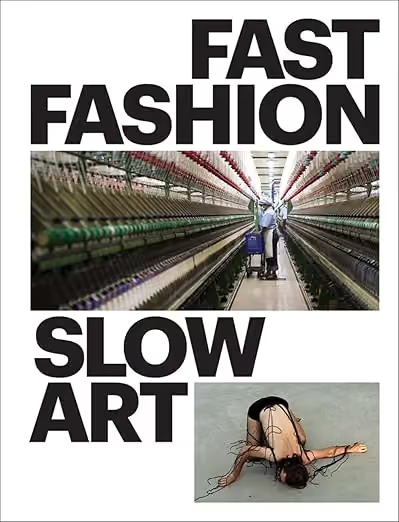
Shein's ultra-fashion model is built on immediacy and ephemeral trends. The brand releases thousands of new products every day, based on digital trends, celebrity viral moments, and — quite often — literal knock-offs of successful designs from other retailers and independent designers. The speed is unprecedented. Where traditional fashion houses operated on seasonal calendars, and fast fashion brands like Zara and H&M compressed those cycles to weeks, Shein operates on the scale of hours.
Shein's model proved so commercially successful that other fashion brands have followed its lead. Mall brands that once launched bimonthly collections now drop monthly capsule lines or even biweekly product releases in stores and online. The constant renewal creates a psychological pull: the feeling that there is always something new waiting encourages consumers to return to the site or store more regularly, compressing the gap between desire and purchase.
Ultra-Fast fashion and Emotions
Shopping is an emotional experience, one that connects our psychology to our wardrobe. We imagine the possibilities of what fashion can be when we try on clothes, encounter advertisements, or scroll through digital campaigns on social media. What is often overlooked is that the systems through which we encounter clothes are just as intentionally designed as the clothes themselves. Shein's website is engineered to function as an endless scroll, a digital environment in which consumers can spend hours browsing without reaching a natural stopping point. Bold banners advertising temporary deals anchor the homepage, creating urgency — and yet, somehow, there is always another deal ready to take its place.This is a model that Shein made popular yet other fashion retailers have continued to expand and encourage in their websites, mailers, newsletters and social media ads. The psychology of pushing letting them know that goods are scarce and that they may not be available tomorrow, triggers an impulsive reaction that more often than not concludes on purchases.
This is not accidental. It is the result of deliberate interface design calibrated to exploit the dopamine loop that underpins compulsive browsing. Fashion has always understood the emotional register of desire; Shein simply industrialized it.
Shein's Online Marketing
Shein's cultural ascent was inseparable from TikTok's rise. The Chinese digital platform and the Chinese fashion brand targeted the same young consumer simultaneously, and the results were symbiotic. Micro-influencers began recording short-form "unboxing" and "haul" videos to share their orders with followers, turning personal purchases into promotional content. Shein became a platform of continuous stimuli: new products, rock-bottom prices, and the social proof of a peer holding up a $7 dress on camera.
In many ways, Shein elevated the micro-influencer industry — those creators whose content is niche and whose following sits below 100,000. Rather than paying market rates, Shein offered these influencers large discounts or free products in exchange for posts, which their audiences received as personal recommendations rather than advertisements. The arrangement benefited both sides financially. Shein avoided the six-figure fees that major celebrities command for a single story post, while micro-influencers gained product, visibility, and the social currency of being associated with a brand their followers already knew.
Shein and Labor
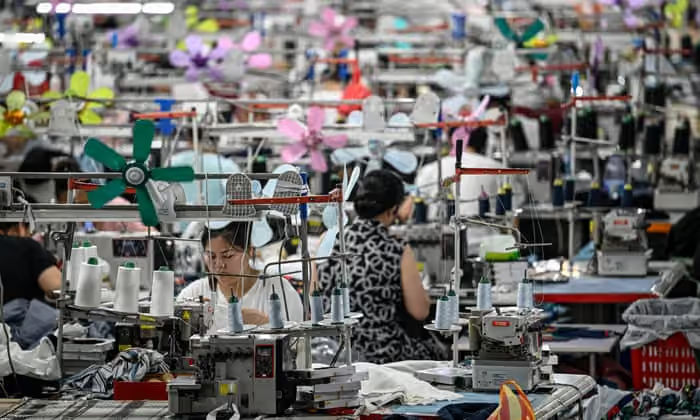
It did not take long for the consequences of this model to surface. Reports and reviews of Shein's product quality began circulating almost as quickly as the haul videos themselves. These are, in many cases, disposable clothes — items ordered for a single wear, or discarded still in their packaging without ever being put on. But the more troubling revelations came from inside the supply chain. A 2021 documentary reported that factory workers producing Shein's garments were working sixteen-hour days with no days off during their first month of employment. These are conditions that violate Chinese labor law. Workers who made sewing errors were reportedly penalized with deductions amounting to roughly three-quarters of a day's wages.
When we observe other fashion brands replicating Shein's emotional mechanics and accelerated production cycles, it is worth asking a harder question: are they also replicating its labor practices? The two tend to travel together. Ultra-low prices require ultra-low production costs, and ultra-low production costs require someone, somewhere, to absorb conditions that the consumer never sees.
Data as a Marketing Tool

Every click, every pause, every abandoned cart is a data point. When consumers accept cookies and navigate online retail spaces, engineers and analysts on the other side of the interface are aggregating that information into behavioral profiles. Are you more likely to make an impulsive purchase during your morning commute or late at night before sleep? How many items do you typically buy per order? Does free shipping tip your decision? Shein has mastered the use of behavioral data to personalize the experience with remarkable precision, ensuring it can capture and retain consumer attention across millions of simultaneous sessions.
This data infrastructure is not unique to Shein. In fact, every major digital retailer employs some version of it. What distinguishes Shein is the scale at which it operates and the sophistication with which it converts behavioral insight into purchase behavior. The algorithm knows what you want before you do. And it makes sure you find it.
A Planet That Cannot Wait
The immediacy that defines ultra-fast fashion: thousands of new styles daily, disposable prices, dopamine-optimized interfaces verbalized by influencers — has produced something the industry rarely discusses honestly: a structural incentive to generate waste. The fashion industry is among the world's largest polluters. It accounts for roughly 10 percent of global carbon emissions, is the second-largest consumer of water, and is responsible for massive quantities of microplastic pollution entering oceans through the washing of synthetic garments. Every polyester dress ordered, worn once, and discarded sends microscopic fibers into waterways that no filter can fully capture.
The planet has been sending signals for years. Wildfires that consume entire regions. Glaciers retreating at rates that climate scientists describe with visible alarm. Flooding in cities that were never designed for water at that scale. The fashion industry is not the sole cause of any of these events, but it is a meaningful contributor — and the ultra-fast model that Shein has both embodied and exported accelerates those contributions with every new product dropped.
What is striking is not that consumers are unaware of this. Awareness of fashion's environmental impact has never been higher. Documentaries, investigative journalism, and activist campaigns have placed the industry's footprint into public consciousness with increasing frequency. And yet, global demand for ultra-fast fashion continues to grow. The collective response has not been to consume less; it has been to scroll further down. There is a psychological mechanism at work here that deserves serious attention: in a world of compounding crises that involves economic, political and environmental issues, the low-stakes pleasure of a $6 blouse offers a moment of control. Retail therapy is not called therapy for nothing. It promises, however briefly, that things can be made better by acquiring something new.
But this is a transaction the planet can no longer sustain.The factory workers producing Shein's garments, the cotton farmers dealing with drought, the coastal communities watching sea levels rise: these are not separate stories from the one about a $4 bikini top going viral on TikTok. They are the same story, told from different angles.
The question is not whether we know what is coming. For a very long time, we have known what’s going on here. The question is whether we are prepared to let fashion be part of the answer rather than an accelerant of the problem. We would need more than consumer choices but eagerness and willingness to understand the cost behind the label hanging on the clothes we are wanting to purchase.
The SHEINification of fashion is not inevitable. But reversing it will demand the kind of collective attention we have, so far, found easier to redirect toward a new haul.


.avif)